Do not just picture the future. Build the bridge to it.
A Mogressive vision board is not a wish list. It is a visual self-leadership tool that helps you name the future, connect it to your why, identify the obstacles, and turn the vision into specific next moves. Choose the free template that fits your season.
A vision board is a starting point — not the strategy.
Looking at a dream does not automatically create the behavior required to reach it. That is why Mogressive pairs visualization with realistic obstacles, specific goals, implementation plans, and repeated reflection.
Dreaming helps you see it. These habits help you do it.
No complicated research talk. Just three useful things to remember when you build your board.
Write the goal down.
People who wrote down their goals followed through better than people who only kept the goal in their head. The study is commonly summarized as roughly a 42% better chance of achieving the goal.
Research: Dominican University goal study
Give your goal an “if–then” plan.
Researchers looking across 94 tests found that simple plans like “If this happens, then I will do this” helped people follow through on their goals.
Research: National Cancer Institute
Just picturing success is not enough.
Research found that only fantasizing about the perfect future can actually lower the energy people put into making it happen. Picture it — then make a move.
Research: Goal-pursuit research
*The “≈42%” figure is the widely cited summary of Gail Matthews’ goal study. Dominican University’s original research summary states that participants who wrote their goals down accomplished significantly more than participants who did not write them down.
Choose the board that matches how your brain works.
The current Mogressive system has always used two types of vision boards: image-based boards and mapping boards. The redesign makes the difference clearer.
See the future.
Use images, words, phrases, quotes, places, people, milestones, and symbols that represent the life or outcome you are working toward.
- ✓Best for visual thinkers
- ✓Creates an emotional connection to the goal
- ✓Useful as a visible reminder of your “why”
- ✓Works best when paired with an action plan
Build the route.
Break the vision into goals, checkpoints, obstacles, time frames, course or career steps, values, affirmations, and specific next actions.
- ✓Best when you need structure, not just inspiration
- ✓Connects long-term vision to short-term action
- ✓Creates checkpoints you can review and adjust
- ✓Mogressive recommended for execution
Start with the version built for your current season.
I kept the existing Mogressive downloadable resources and reorganized them into three clear pathways.
College Vision Board
Map graduation, transfer, courses, academic priorities, personal goals, values, career direction, affirmations, and the person you want to become after college.
- ✓Weekly, short-term, and long-term goals
- ✓Course-specific goals
- ✓Values, passion, beliefs, and “why am I in school?”
Life & Goal Vision Board
Build direction across work, community, finances, health, wellness, relationships, personal goals, values, affirmations, and the next season of your life.
- ✓Work and community
- ✓Finance and personal goals
- ✓Health, wellness, family, and friends
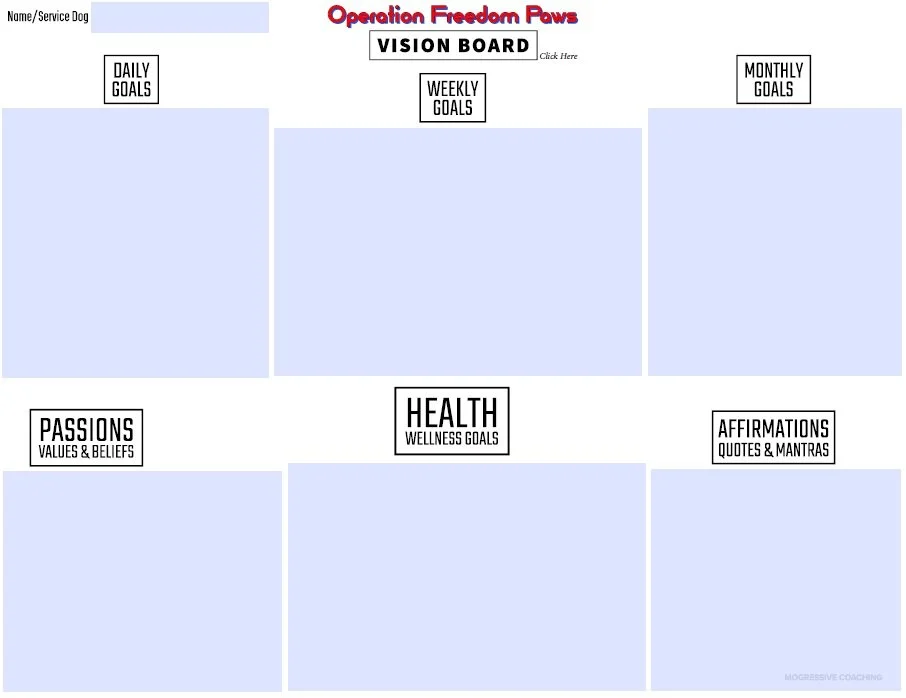
Veteran Vision Board
A structured board designed around daily, weekly, and monthly goals; values and beliefs; health and wellness; affirmations; and rebuilding direction during transition.
- ✓Daily, weekly, and monthly goals
- ✓Passions, values, and beliefs
- ✓Health, wellness, affirmations, and accountability
Build the board. Then make it move.
This is the part that keeps a vision board from becoming wall decoration.
Name the Future
Choose the outcome or life direction you actually want — not what sounds impressive to other people.
Attach the Why
Write why the goal matters, what it represents, and who benefits if you follow through.
Find the Obstacle
Name the real friction: time, money, fear, habits, skill gaps, environment, support, or competing priorities.
Create the Next Move
Turn each important vision into one specific action with a date, place, trigger, or checkpoint.
Review & Pivot
Look at the board weekly. Keep what still matters, update the route, and remove goals that no longer fit.
Every vision needs a behavior underneath it.
“Graduate” is a vision. “Study biology from 6:00–7:00 PM Tuesday in the library” is a behavior. “Get healthier” is a vision. “Walk for 20 minutes after lunch Monday, Wednesday, and Friday” is a behavior.
If I looked at this board today, what action should it cause me to take before the day ends?
Give the goal a trigger.
One practical strategy from implementation-intention research is to connect a situation to a planned behavior: “If X happens, then I will do Y.”
- ✓If it is Sunday at 6 PM, then I review my board and choose the week’s three priorities.
- ✓If I finish class Tuesday, then I go directly to office hours.
- ✓If I receive my paycheck, then I automatically move my planned amount toward the savings goal.
The board matters because of what it helps you do next.
“The goal setting was my biggest takeaway because I learned how I can take baby steps to achieve the bigger goal in my academic career.”
— Lhea Aragon, Mogressive Graduate / Veteran / College“I have spent a long time going with the flow. Recently I have taken control and made decisions with good intentions and my world has changed.”
— Mark Hinojosa, Mogressive Graduate / College StudentA board can show the direction. A system helps you keep moving.
If your vision board exposes bigger questions around identity, goals, routines, confidence, pressure, or self-leadership, use the next Mogressive layer that fits you.
College Courses & Free Student Tools
Use the new College resource library for goals, journaling, reflection, direction, confidence, and personalized College Stuck Quiz pathways.
6-Week Mogressive Course
Go deeper into values, goals, vision boards, mindset, routines, choice, reaction, reflection, and building a repeatable growth system.
Work 1:1 With Coach Mo
Build your vision board around your real life, current season, obstacles, priorities, values, and next moves with direct coaching.
Make the vision useful.
Do vision boards really work?
A board by itself is not a guarantee of goal achievement. Mogressive uses it as a tool for clarity and direction, then adds specific goals, obstacles, implementation plans, next actions, and review — the pieces more strongly supported by goal-pursuit research.
Should I build an image board or a mapping board?
Choose an image board if visual inspiration helps you stay connected to the future. Choose a mapping board if you need more structure. You can also combine both: images for the destination and mapping for the route.
How often should I look at my vision board?
Use it often enough to drive action. Mogressive recommends a short weekly review where you check progress, identify obstacles, choose the next moves, and update anything that no longer fits.
Can I change my goals after I build the board?
Yes. Reflection and pivoting are part of the Mogressive process. A goal that no longer fits your values, responsibilities, information, or season does not have to remain on the board just because you once chose it.
Are the templates really free?
Yes. The College, Adult/Goal Getter, and Veteran vision board PDF links on this page are provided as free Mogressive tools.
What should I do after I finish the board?
Choose one goal and create one next action. Then decide when and where you will do it. The board becomes valuable when it changes behavior outside the board.
The board does not build your future. Your next move does.
Use the vision board to see what matters. Use the map to understand the route. Then make one decision today that gives the future version of you actual evidence.
Mogressive vision boards are self-awareness, goal-setting, reflection, and personal-strategy tools. They are not medical, clinical, financial, or mental-health advice.
Vision boards are a great way to visualize what you want in life. They can be used for a variety of purposes, but their main focus is for college students to use them as a tool to help with the transition from high school to college, and college to beyond!
College students often have trouble visualizing themselves fitting into the world of academia and this is where vision boards come into play.
Our templates break down step by step & all the “how to’s” in setting up your vision board at home, work, or school. Click Here
College Students
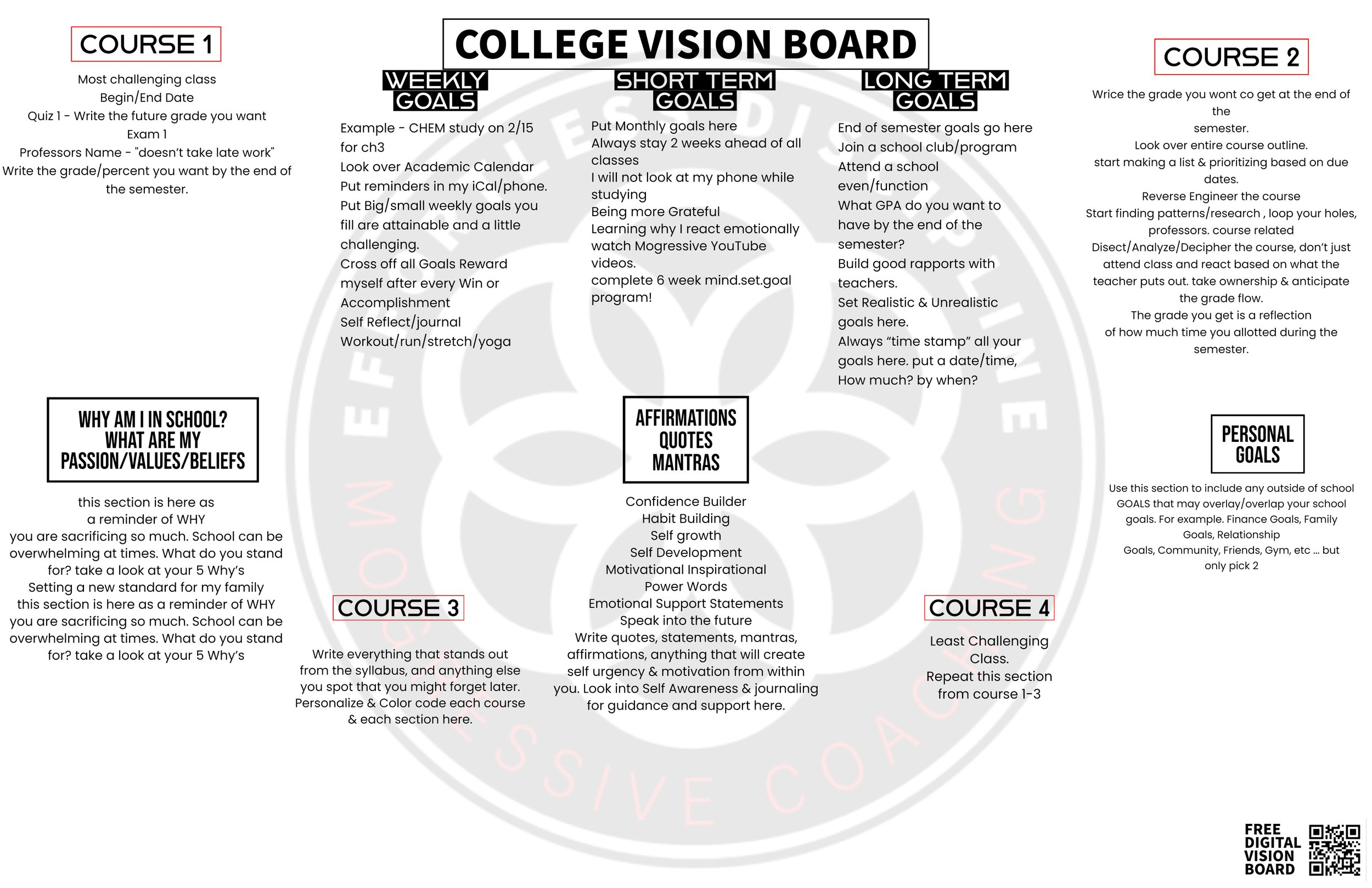

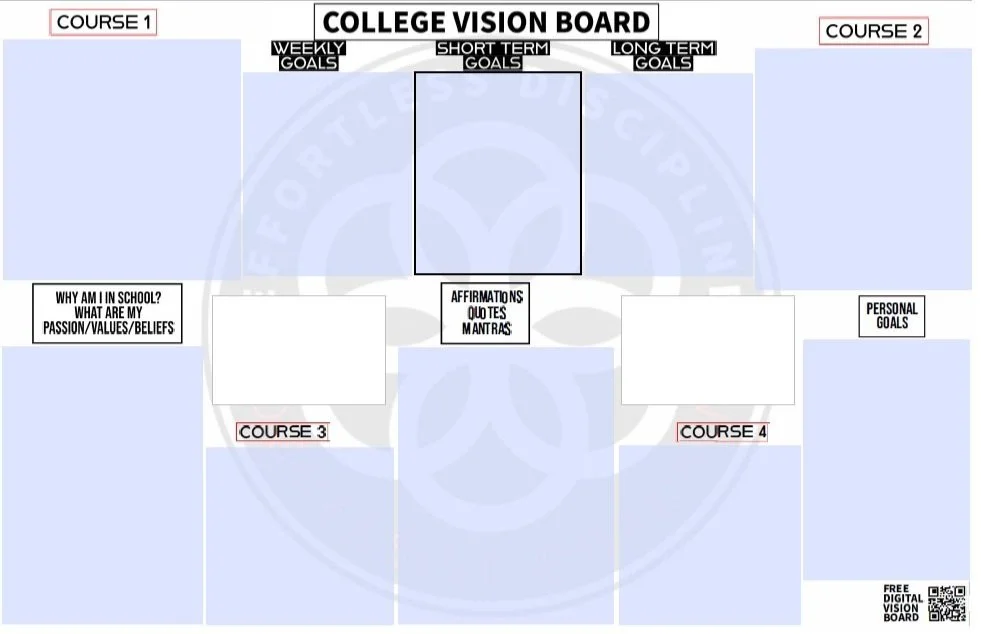
Download Our Fillable Templates
Adults Goal Getters
Vision boards are a great way to get your creative juices flowing and set goals for yourself. They're also a great way to keep track of your achievements as you work towards your goals.
A vision board is a collection of images, words, or phrases that represent what you want in life. It can be anything from a collage of photos of your dream home, family, and lifestyle to images of the car you want or even pictures that represent how you want to feel on a daily basis.
Our Cheat Sheet & Templates break down step by step & all the “how to’s” in setting up your vision board at home, work, or school. Click Here


I’ve created vision boards because they work, there are 2 types of Vision Boards, Collage & Mapping.
Collage Vision Boards are a collection of pictures that fit your current goals and future life/goals.
Mapping Vision Boards are a full breakdown, like brainstorming goals, setting checkpoints, reminders, and attaching a deeper meaning to each goal.
I’ve created digital templates for Veterans with Service dogs, to help self accountability, pushing comfort zone boundaries, and creates daily self motivation while enrolled in a service dog program or organization. Writing down a goal on paper increases your chances of achieving that goal by 33%
My life changed with Operation Freedom Paws, click here to start your journey.
Service Dog Veterans
Vision Board Examples

Vision Board Videos
“What really Matters”
Vision Board Hacks
Vision boards are usually made with pictures and words that represent the things you want to have, do, or be. These images and words can be cut out of magazines or drawn by hand. They can also be collected from around the house (e.g., postcards, photographs).
Start cutting out images of things you want in the near future. Always timestamp your goals, “how much & by when” Example: Lose 10lbs, by Dec 1st. Keep breaking down your goals.
Just by writing down your goals on paper or on a vision board you increase your chances of achieving them by 42%